
The short answer
AI automation is software that runs business tasks on its own and uses artificial intelligence for the steps that used to need a person to read, write or decide. A trigger starts it, a language model handles the messy part, such as understanding a customer message, and connected tools take the action: reply, update the CRM, book the call.
Searches for "what is AI automation" rose 80% in Australia and 50% in the US over the three months to November 2026, while "AI automation agency" and "AI automation specialist" climbed in Australia and the UAE. Most guides are written by software vendors. This one is written for business owners by Mubeen Khan, performance marketing consultant in Dubai, who builds AI automation behind ad campaigns: what it is, where it pays, what it costs and how to start.
What is AI automation?
AI automation is software that runs a business task on its own and uses artificial intelligence for the steps that used to need a person to read, write or decide. A trigger starts the workflow, a language model handles the messy part, and connected tools take the action. Plain automation follows fixed rules; AI automation can deal with input it has never seen before.
Under the hood, the "intelligence" is usually a large language model (LLM) such as GPT, Claude or Gemini, sometimes alongside machine learning or natural language processing (NLP) models. They turn unstructured input, such as an email, a WhatsApp voice note or a PDF, into a decision: what the customer wants, how urgent it is, and what should happen next.
What is automation, with an example?
Automation is using software to do a task with little or no human effort. Example: when someone fills in your website form, a workflow adds them to your CRM, emails them a confirmation and alerts your sales team. It follows the same if-this-then-that rule every time, which makes it cheap and reliable, but it cannot understand anything outside that rule.
How does AI automation work?
Every AI automation has three parts: a trigger, an AI step and actions. The trigger is an event, such as a new lead or a booked call. The AI step reads and decides. The actions are what the tools then do. Here is the same new lead handled both ways.
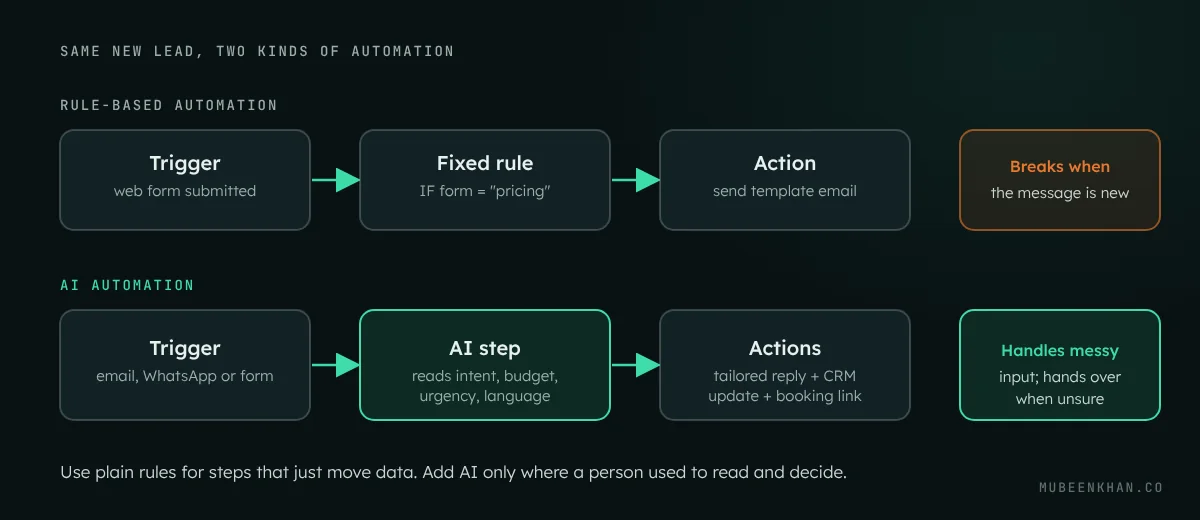
A good rule of thumb from people who build these systems: use plain rules for steps that just move data or send at 9am, and add AI only where the input is messy. Those rule-based steps are cheaper and they do not surprise you. When the AI is unsure, the workflow should hand the case to a person.
| Factor | Rule-based automation | AI automation | AI agent |
|---|---|---|---|
| What it does | Runs fixed steps | Runs steps, with AI reading and deciding inside them | Plans its own steps towards a goal |
| Input it handles | Structured data only | Emails, chats, documents, calls | Open-ended conversations and tasks |
| Predictability | Very high | High, with guardrails | Lower, needs close monitoring |
| Typical example | Form to CRM to email | Classify and answer a lead, then book | Qualify, negotiate a slot, follow up for days |
| Best first use | Reminders and reports | Lead replies and inbox sorting | Once simpler automations are proven |
Robotic process automation (RPA) is an older cousin: bots that click through screens like a person would. Many vendors now add AI to RPA, but for a small business the cheaper route is usually connecting apps through their APIs with tools like Zapier, Make or n8n. If you want the agent end of the spectrum, read what AI agents are and how they work.
What is AI automation with an example?
The clearest example is lead response. A new enquiry arrives from an ad at 11pm. AI reads it, works out the service, budget and urgency, replies in the customer's language within seconds, scores the lead in the CRM and sends a booking link to qualified buyers. Your team starts the morning with booked calls instead of a pile of unread messages.
Other AI automation examples that pay off for small businesses:
- Inbox sorting: AI labels every email as sales, support, invoice or spam and drafts the reply for a person to approve.
- Call summaries: after each sales call, AI writes the notes and next steps into the CRM.
- WhatsApp answers: AI replies to price and availability questions from your own documents. See WhatsApp AI chatbots.
- Missed calls: an AI receptionist answers, books and texts a summary.
- Reporting: every Monday, ad, CRM and sales numbers are pulled into one plain-English summary.
Automation earns its keep fastest when it fixes follow-up after paid ads. For a healthcare brand in the UK and US, Meta Ads combined with an automated booking funnel lifted revenue 76%, from £223,090 to £392,668, comparing May 2022 to September 2023 with the year before.

Which tasks should a small business automate first?
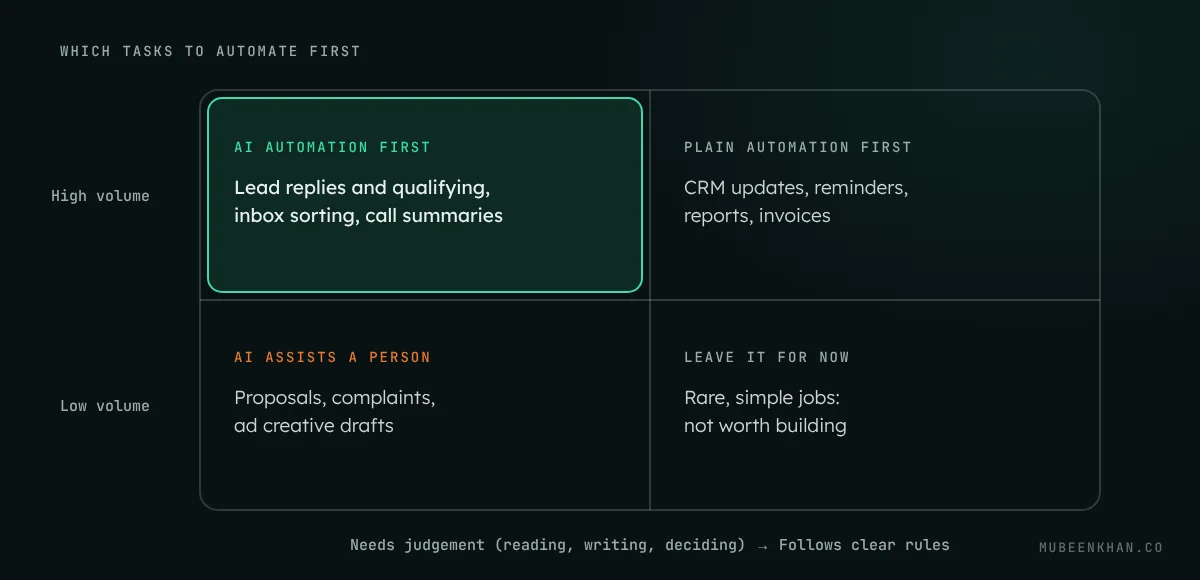
Automate first the tasks that happen often and are time-sensitive. Use AI only where the task needs reading or judgement; use plain automation where it follows clear rules. Leave rare, simple jobs alone, because they are not worth the build.
Small businesses are already moving. Bluevine's 2026 Small Business AI Trends Report found 74% of owners are using or actively testing AI tools, but 82% have hit at least one barrier when trying to go deeper, and concern about data security rose from 23% to 33% in a year. Starting with one narrow, measurable workflow avoids most of those barriers.
What are the top AI automation tools, and what do they cost?
The five tools small businesses use most are Zapier, Make, n8n, GoHighLevel and the built-in AI in tools they already have, such as Microsoft Copilot or Google Gemini. Prices below were checked on the vendors' pricing pages on 11 November 2026 (n8n and GoHighLevel in October 2026) and change often.
| Tool | Best for | Starting price |
|---|---|---|
| Zapier | Fast, simple app-to-app workflows with AI steps | Free (100 tasks a month); Professional from $19.99 a month |
| Make | Visual, multi-branch workflows at low cost | Free (1,000 credits a month); Core from $9 a month billed annually |
| n8n | Long workflows and AI agents; self-hosting | Self-hosted Community Edition free; Cloud from €20 a month billed annually |
| GoHighLevel | CRM, funnels, WhatsApp and SMS follow-up in one place | From $97 a month |
| Copilot or Gemini | AI inside email, documents and spreadsheets | Add-on to Microsoft 365 or Google Workspace |
On top of the platform, expect AI model usage, usually a few cents per conversation, and the build: writing the rules, connecting your apps and testing. For a deeper look at one of these tools, see what n8n is and how it works.
How can I get started with AI automation?
Start with one workflow that has a number attached to it, such as reply time to new leads or hours spent on the inbox. Map it on paper, build it with plain automation, add one AI step where a person currently reads and decides, then test it on real past cases before turning it on.
- Pick one taskChoose a frequent, time-sensitive job. For most businesses running ads, that is the first reply to a new lead.
- Write down the rulesWhat a good lead looks like, what the AI may say, and when it must hand over to a person.
- Choose the toolZapier or Make for simple flows, n8n for long or AI-heavy ones, GoHighLevel if you also need a CRM and messaging.
- Test on real casesRun last month's enquiries through it and read every output before going live.
- Measure the return, then expandTrack reply time, bookings and hours saved. Add the next workflow only when the first one pays.
Should you hire an AI automation specialist or agency?
Build it yourself if the workflow is simple and you enjoy the tools. Hire an AI automation specialist when the automation touches revenue, such as leads from paid ads, because a broken workflow costs you customers silently. An agency suits large projects across many departments; a specialist suits a small business that wants one senior person.
A good specialist will ask about your sales process before talking about tools, show you real examples, and set up logging so you can see every action the automation takes. I build AI automation that sits directly behind Meta and Google Ads campaigns, so every lead is answered and qualified buyers land in the calendar. See AI automation services or, for the UAE, AI automation in Dubai.
AI automation questions
Is AI automation the same as an AI agent?
No. AI automation runs a set workflow and uses AI inside some of its steps, for example to read a message and decide which reply to send. An AI agent is given a goal and plans its own steps and tool use. Most small businesses should start with AI automation, which is more predictable, and add agents later.
How do businesses make money with AI automation?
Businesses make money with AI automation by answering leads faster, so more of the people their ads already paid for become customers, and by cutting staff hours on repetitive work. The gains are largest where enquiries arrive out of hours or in high volume, such as clinics, restaurants, real estate and e-commerce.
What skills are needed for AI automation?
You need clear process thinking more than coding: the ability to map a task step by step, write precise instructions for the AI, and test edge cases. Comfort with tools like Zapier, Make or n8n, basic knowledge of APIs and webhooks, and an understanding of the business goal behind the workflow complete the skill set.
Will AI automation replace jobs?
In small businesses, AI automation mostly replaces tasks, not people. It takes over first replies, data entry, sorting and summaries, especially out of hours, so staff spend more time on sales calls, service and decisions that need judgement. Roles that consist almost entirely of repetitive data handling are the most exposed.
Is AI automation safe for customer data?
It is safe when it is set up with narrow permissions. Give each workflow access only to the apps it needs, keep payments and deletions out of reach, check where your AI provider processes data, log every action and keep a person in the loop for refunds, complaints and anything legal or medical.
How long does it take to set up AI automation?
A single focused workflow, such as instant replies and booking for new leads, usually takes one to two weeks including testing. Connecting a CRM, WhatsApp and calendar or adding call handling takes longer. Starting small means you see results within the first month and can decide what to automate next.
Running ads and losing leads to slow follow-up? Book a free strategy session and I will show you which AI automation would pay for itself first.

Performance marketing consultant based in Dubai. $5M+ in Meta and Google ad spend managed for 50+ businesses in the UAE, USA, UK, Australia and New Zealand. About Mubeen · LinkedIn · Facebook · Instagram